For a full and up-to-date list of my publications, check out my GoogleScholar page.

Soft sensors
They stretch! They measure! Most importantly, they are reliable!
These sensors are constructed as stretchable parallel-plate conductors using an expanded graphite & silicone composite for the conductive layers, and pure silicone for the dielectric layers. Because of their reliability, the sensors have been used in a wide variety of projects in my lab and by collaborators. Key takeaways from rigorous characterization: sensor performance is agnostic to variations in manufacturing, the sensors have a linear response to strain with no hysteresis, they still operate after undergoing 100,000 cycles of strain to 50%, and they still function after being stretched to 300% strain.
Variable stiffness materials
In order to be useful, soft robots can’t always be ‘soft’. Variable stiffness materials are useful for switching from a soft, deformable state to a stiff, load-bearing state, allowing structures to be reconfigured on-the-fly.


Robotic fabrics
What are robotic fabrics? Think Iron Man but instead of that metal suit, it’s your clothes that augment strength and provide support. That’s the idea behind robotic fabric (and more broadly, robotic skins): planar robots that can wrap around soft objects (like human limbs), and impart motion on them.
Liquid metal electronics
Liquid metals are exactly as the name suggests: metallic properties in a liquid state of matter. This combination makes them especially useful for stretchable and flexible electronic devices.

Soft material actuators
Soft robots need actuators that are also soft. To build these soft “motors”, these actuators also need to constructed using soft, stretchable materials. One approach is dielectric elastomer actuators, which leverage Maxwell stress to create soft actuators that extend in response to applied voltage.
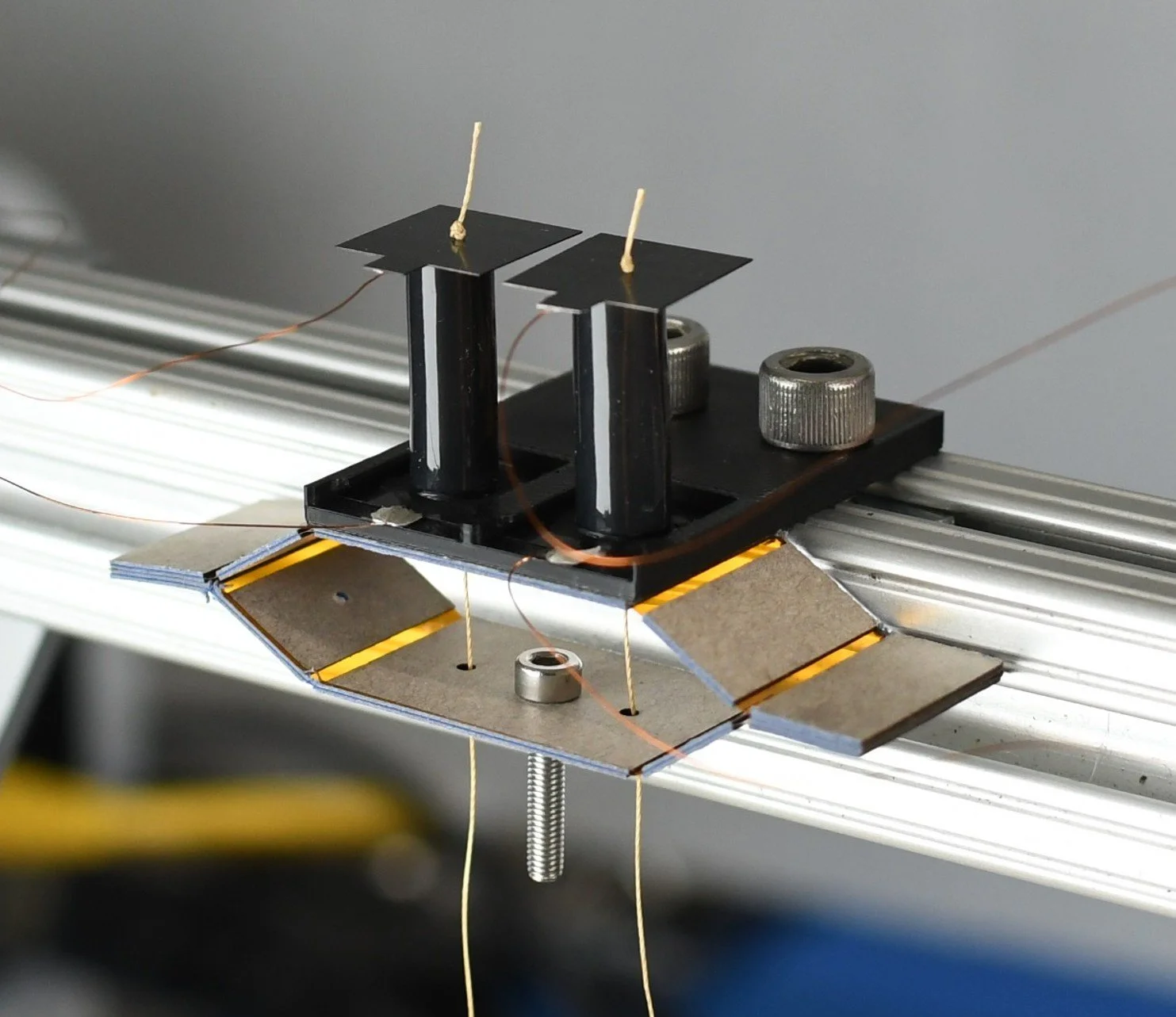
Dielectric elastomer actuator driving motion of a compliant structure.