


Reconfigurable electronic devices enabled by laser-sintered liquid metal nanoparticles
The hybrid approach presented here consists of liquid metal traces patterned onto an etched copper flex PCB with soldered-on ICs. The utility of this approach lies in the versatility of the laser-sintering process required to pattern conductive traces (light grey) in the liquid metal nanoparticle film (dark grey - non-conductive). The physical geometry of the sintered pattern is used to govern the electrical resistance (zigzag patterns) or capacitance (interdigitated pattern). The same laser-processing step can be used to design kirigami slit patterns to enable stretchability in the flex PCB.
S. Liu*, M. C. Yuen*, and R. Kramer-Bottiglio, “Reconfigurable electronic devices enabled by laser-sintered liquid metal nanoparticles,” Flex. Print. Electron., vol. 4, no. 1, p. 015004, Feb. 2019.


Self-sintering liquid metal colloidal inks for facile manufacture of stretchable conductors
Self-sintering liquid metal particle inks eliminate the need for separate deposition and sintering steps, which allows for more rapid fabrication. Here, we show that by using water as the solvent for the liquid metal particles, we can leverage its higher surface tension to cause particle coalescence via its evaporation.
M. C. Yuen, M. A. Creighton, and C. E. Tabor, “Self-sintering liquid metal colloidal inks for facile manufacture of stretchable conductors,” in 2020 3rd IEEE International Conference on Soft Robotics (RoboSoft), May 2020, pp. 676–681, doi: 10.1109/RoboSoft48309.2020.9116043.
Liquid metal inks for RF transmission
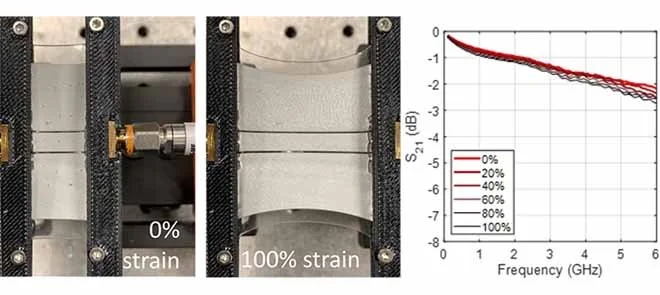
The liquid metal transmission line continues to transmit with little change in performance, even when stretched double its initial length.
Much of the work on stretchable electronics using liquid metals as a stretchable conductor has focused on low-frequency (<1kHz) operation. Here, we investigate the use of a liquid metal-based ink as a conductor for radio frequency (1-10GHz) transmission lines. We demonstrate that the strain-insensitivity of this liquid metal ink persists from DC measurements to RF operation. We characterized the transmission performance as the liquid metal-based transmission line was subjected to strains up to 300% strain and undergoing 1000 cycles of strain.
A.M. Watson, M. C. Yuen, and C. E. Tabor, “Characterization of Liquid Metal Inks for RF Applications,” IEEE Journal on Flexible Electronics, vol 4 (9), pp. 362-372, May 2025, doi: 10.1109/JFLEX.2025.3573959.